Visual Evidence
Architectural Artifacts
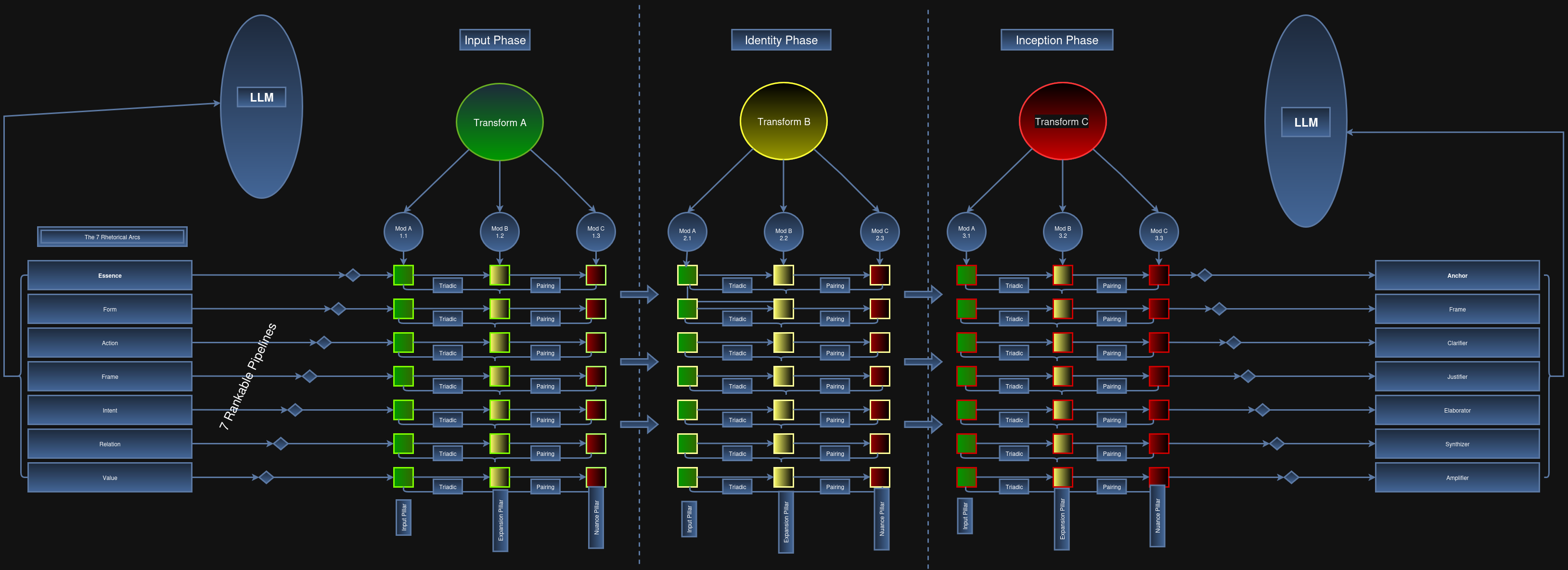
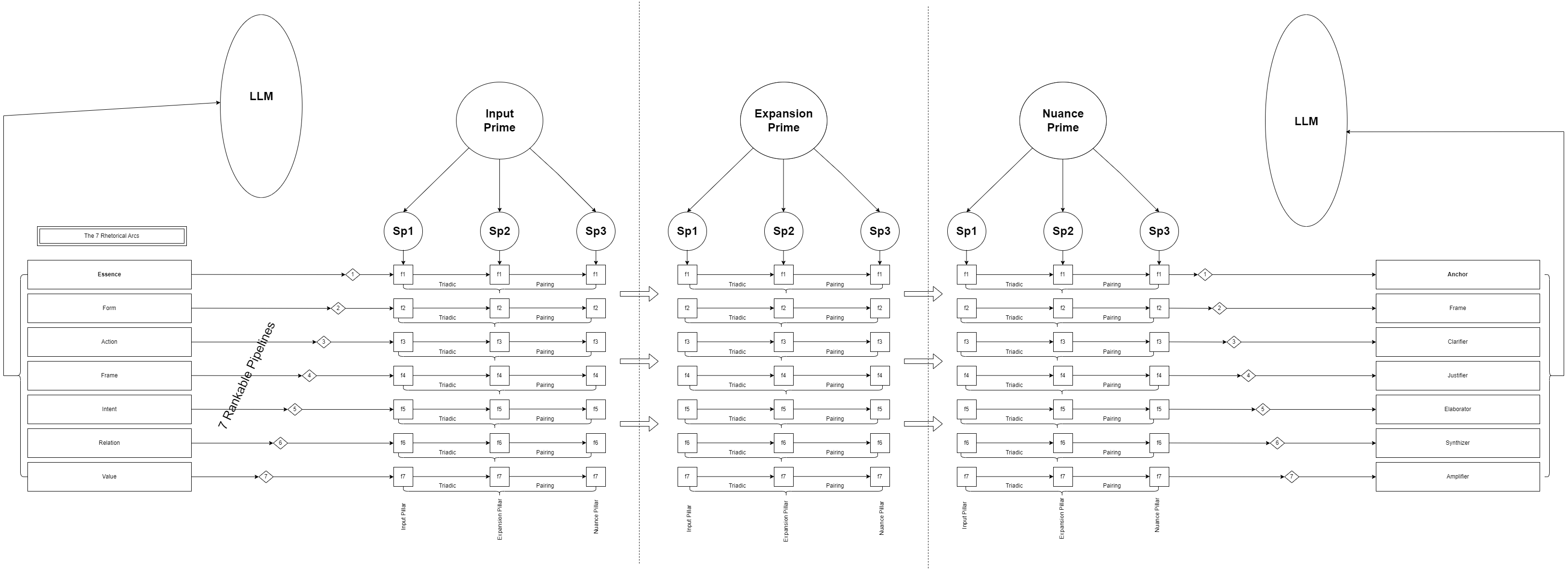
Evidence-Based Validation Logs
Categorical Evidence Tiers
Validation of spatialized state persistence and retrieval accuracy across non-linear timelines.
Validation of 7-Arc decomposition accuracy and triadic reasoning consistency.
System-Specific Validation
| System | Claim / Demonstration | Type | Status |
|---|---|---|---|
| SYS-001 | 7-Arc structural logic decomposition | Code Modules | Implemented |
| SYS-002 | 343-node holographic memory persistence | Runtime Exec. | Implemented |
| SYS-003 | Fractal recursion logic for goal state | UI Output | Partial |
| SYS-001 | Pre-linguistic ideation layer | Test Results | Experimental |
| SYS-002 | 4D Temporal Gradient Anchoring | Code Modules | Experimental |
| SYS-004 | Multi-galactic affinity propagation | Runtime Exec. | Implemented |
Violation Arc · Conflict Resolution · State Integrity
The MCL includes a built-in quarantine policy. When incoming data conflicts with existing lattice state, the system isolates the violation, logs the conflict, and preserves structural integrity. Below is a real conflict resolution trace.
Why this matters: The quarantine system doesn't rely on probability thresholds or confidence scores. It uses spatial proof — the entity's coordinate history is an immutable fact in the lattice. If the output contradicts the lattice, the output is wrong. No ambiguity.
Fractal Path Readout · Coordinate Shift Visualization
When the AI "drills in" to a concept, the MCL exposes the coordinate shifts in real time. Below is a trace from the Final Dawn of Eideus simulation showing how spatial and temporal keys resolve during an entity encounter.
The key insight: Every line above is a real operation against the MCL. The coordinate path is not a debug artifact — it is the reasoning trace. An auditor can reconstruct exactly which memories influenced any decision by reading the path.
Architectural Artifacts