LOGICAL ENGINE
SUBJECT: Recursive Search & Geometric Movement Search
The Search Kernel
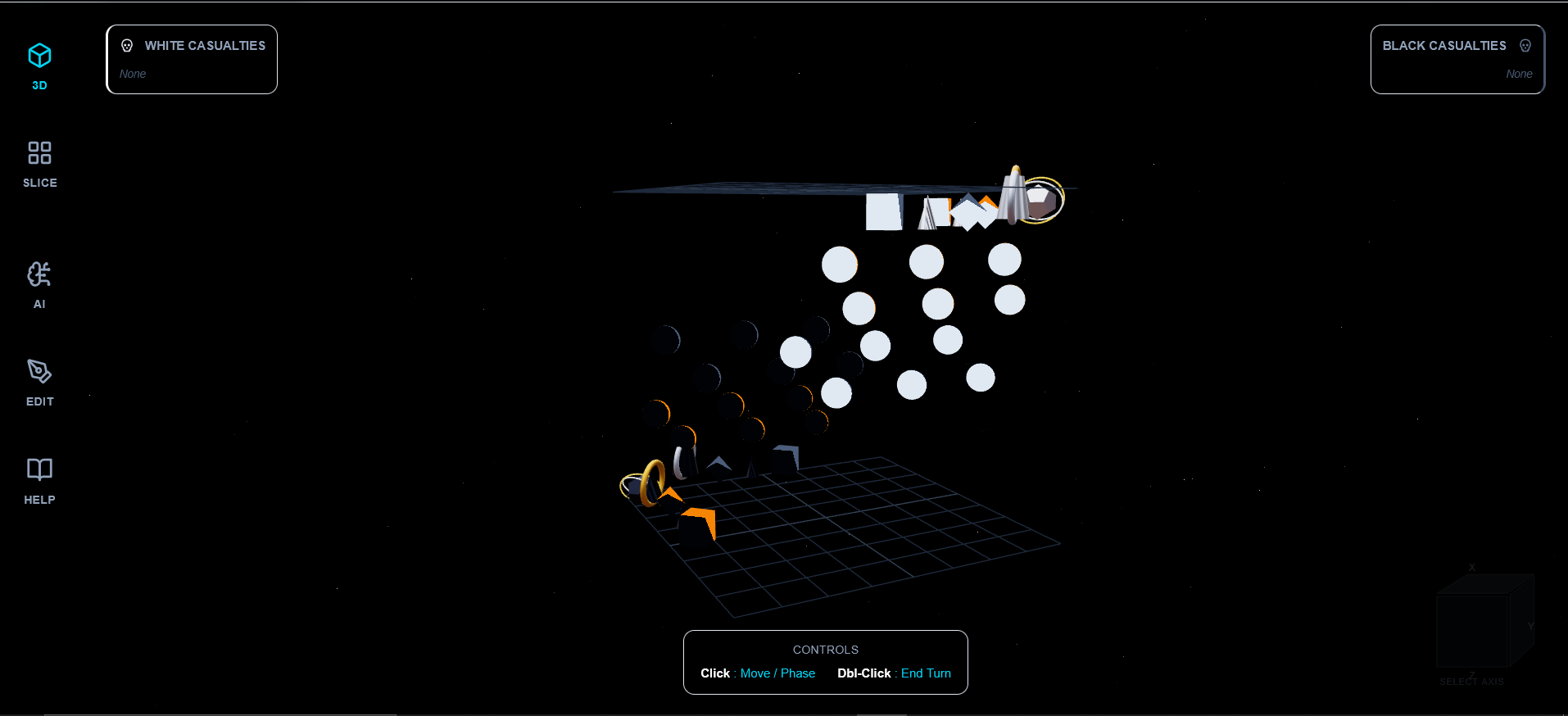
The CubeX³ engine implements a full Recursive Minimax algorithm across an 8×8×8 tensor field — 512 voxels of live board state. The branching factor of true 3D space is orders of magnitude greater than standard chess, forcing an architectural discipline around search depth and computational efficiency from day one.
// RECURSIVE SEARCH DEPTH
The engine prioritizes raw search depth across the 512-voxel state space. This maintains deterministic evaluation despite the massive branching factor, with move ordering prioritizing high-opportunity tensor coordinates to maximize computational throughput.
// TWO-PHASE MOVE RESOLUTION
Certain pieces — Rooks, Bishops, and the Fractal Knight — trigger a second movement phase mid-turn (the "dog-leg" mechanic). The search kernel fully accounts for these chained move sequences within the same Minimax tree, nesting Phase 2 possibilities as sub-branches before evaluation.
Geometric Move Calculator
The `moveCalculator` is a pure-function engine that translates traditional chess movements into 3D vector space. It handles complex triagonal and cross-axis constraints inherent to the 512-cube board.
- Triagonal Vectors: Movement across all three axes (X, Y, Z) simultaneously.
- Collision Avoidance: Real-time pathing checks for line-of-sight pieces (Rooks, Bishops, Queens).
- Fractal Phase Check: Validating movement for 'Fractal' class units with state-dependent rank upgrades.
Roadmap: The Path to Cognitive Depth
To achieve the theoretical maximums of the 8x8x8 lattice, the following engineering milestones are prioritized for the "Exodus" build:
- Iterative Deepening: Allow the engine to search deeper if time permits.
- Quiescence Search: Extend depth for "volatile" positions (captures/checks) to mitigate horizon effects.
- State Optimization: Migration from object-heavy representation to flattened Int32Array/Bitboards to unlock millions of nodes/sec.
// ARCHITECTURAL SIGNIFICANCE
The move calculator established a principle that carries through every subsequent G-ynthetic system: spatial accountability is non-negotiable. A move that cannot be validated against the full 3D coordinate field is not a valid move. This constraint — brutal in a chess engine — translates directly into the hallucination-resistance architecture of the G-ynthetic Lattice, where every output must resolve to an addressable node.